
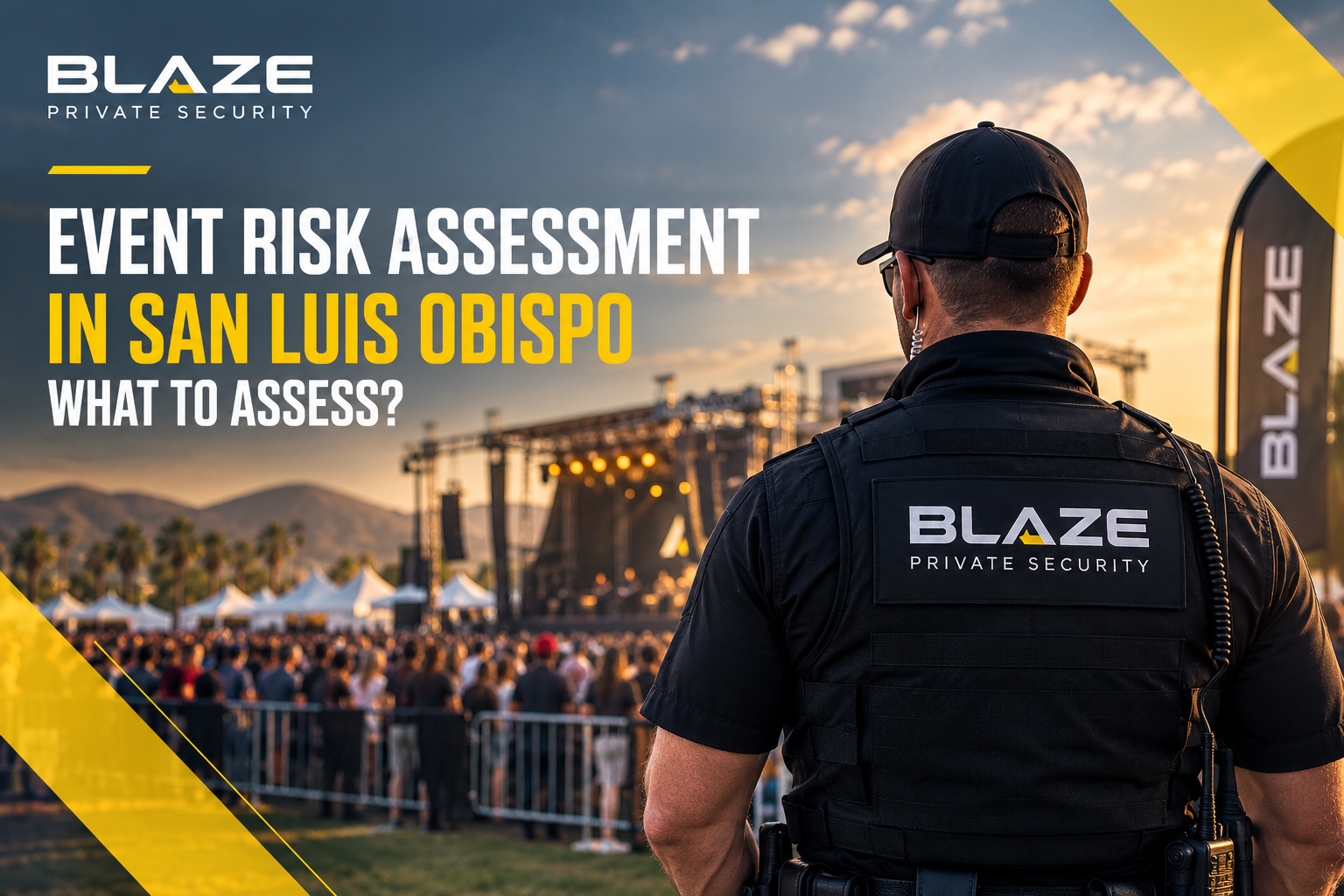
Why Event Risk Assessment Matters for San Luis Obispo Events
Planning security for a special event should start with the risks involved, not with a predetermined number of guards or a standard security package. A concert, festival, fundraiser, athletic event, community gathering, or private celebration can have very different security requirements even when the expected attendance is similar. The venue layout, entrances, parking areas, event activities, operating hours, temporary structures, weather conditions, alcohol service, and crowd behavior can all affect the level of exposure.
That is why an event risk assessment is an important step before selecting security measures. The purpose is not to assume that every possible problem will occur. Instead, organizers can identify reasonably foreseeable risks, determine where the event may be vulnerable, and establish practical measures to reduce those risks before attendees arrive.
San Luis Obispo events can also involve public streets, sidewalks, parks, public facilities, traffic impacts, and other city or county considerations. The City of San Luis Obispo requires special-event organizers to submit an application at least 90 calendar days before the scheduled event, while the application addresses practical planning considerations such as first aid, parking, clear paths of travel, restrooms, signage, transportation, and vendor access.
For organizers who are beginning the planning process, our California event security planning and protection guide provides broader context on security considerations for special events throughout California. From there, the event-specific risk assessment can help determine what protection makes sense for the particular venue and circumstances.
What Is an Event Risk Assessment?
An event risk assessment is a structured review of the conditions that could affect the safety, security, and smooth operation of an event. It considers potential risks, the likelihood that they may occur, the potential consequences, and the vulnerabilities that could make an event more exposed.
In practical terms, we recommend asking five basic questions:
- What could go wrong?
- How likely is the situation to occur?
- What could happen if it occurs?
- Where is the event most vulnerable?
- What reasonable measures can reduce the risk?
The assessment does not have to be unnecessarily complicated. A small community gathering may require a much simpler review than a large outdoor concert with multiple entrances, vendors, temporary structures, parking areas, and a high spectator turnout.
The important point is that the security approach should reflect the actual event. CISA’s event-planning guidance similarly encourages planners to examine venue characteristics, existing security and emergency plans, crowd management, and physical security before determining areas for improvement.
Start With the Event, Not the Security Service
One of the easiest mistakes in event planning is deciding on a security solution before looking closely at the event itself. A better approach is to understand how the event will operate and then determine where security measures can reduce the most important risks.
Event Type and Activities
Start by looking at what will actually happen during the event. A daytime family-oriented gathering may have a different risk profile from a late-night concert, while a fundraiser with cash transactions may create different concerns from an athletic event.
Consider whether the event will involve live entertainment, standing or seated crowds, alcohol service, vendors, merchandise sales, VIP areas, children and families, multiple activity zones, vehicles, production equipment, or restricted areas. These details help establish where security attention may be needed.
Location and Layout
The physical layout of the venue is equally important. Entrances, exits, public walkways, parking areas, service entrances, loading zones, equipment areas, backstage spaces, and open perimeter areas can all create different vulnerabilities.
A venue with several uncontrolled approaches may require a different security approach from a location with clearly defined entrances. CISA’s venue guidance emphasizes conducting a risk assessment and then selecting security measures that address identified gaps while considering the venue’s complexity and available resources.
Attendance and Crowd Movement
Attendance is important, but the number of people alone does not determine the security requirement. How attendees arrive, where they gather, how they move between areas, and where congestion is likely to occur can be just as important.
For example, a large crowd spread across an open park may create different challenges from a smaller crowd concentrated around one entrance or stage. Identifying these movement patterns before the event allows organizers to focus security coverage where it can have the greatest practical effect.
Timing and Environmental Conditions
The time and duration of an event can also change its risk profile. Nighttime events may require greater attention to lighting and visibility, while outdoor events can be affected by heat, rain, wind, or other changing conditions.
The assessment should therefore consider not only what the venue looks like during normal conditions, but also how the event may operate under less favorable conditions.
Common Special Event Risks to Evaluate
An event risk assessment should examine the risks that are relevant to the particular event rather than simply using the same checklist every time.
Crowd and Access Risks
Crowd-related risks can develop around entrances, exits, stages, narrow walkways, food and beverage areas, or other locations where people naturally concentrate. Long lines, congestion, blocked routes, and confusion about where attendees should go can make an otherwise manageable event more difficult to control.
Security measures may include entrance monitoring, controlled access points, visible security presence, crowd observation, and maintaining clear routes. The goal is to identify areas where crowd movement could become difficult and address them before congestion becomes a larger problem.
Unauthorized Access and Restricted Areas
Many events contain areas that should not be open to the general public. Backstage spaces, production areas, staff rooms, vendor storage, loading zones, and cash-handling areas may require additional protection.
The assessment should identify who needs access to each restricted area and how that access will be controlled. Depending on the circumstances, security personnel may monitor access points, verify authorization, or provide a visible presence around sensitive areas.
Parking and Traffic-Related Risks
Parking should not be treated as completely separate from event security. Large arrival and departure periods can create congestion, confusion, and opportunities for unauthorized activity, particularly when parking areas are spread away from the primary event space.
For events affecting public roads or County rights-of-way, traffic control and route planning can also become part of the broader event-planning process. San Luis Obispo County’s special-event requirements address situations involving traffic control, route markers, road or lane closures, and other activities in County rights-of-way.
Property, Theft, and Cash-Handling Risks
Temporary events can involve valuable equipment, merchandise, personal belongings, cash, production materials, and other property. The assessment should identify locations where these assets are concentrated and determine whether they need additional monitoring or access restrictions.
For example, a production area containing expensive audio equipment may need a different level of attention from a general public seating area. Similarly, a vendor handling significant amounts of cash may require consideration during the event’s security planning.
Weather and Environmental Risks
Outdoor events require planners to consider environmental conditions that could affect attendees, staff, equipment, and emergency access. Excessive heat, strong winds, rain, poor visibility, or changing ground conditions can create additional challenges.
The security team does not replace emergency-management or medical personnel, but security personnel can play an important supporting role by observing conditions, communicating concerns, helping maintain access routes, and directing attention to developing situations.
Medical and Emergency Risks
Medical incidents can occur at events even when no security threat is present. An assessment should therefore consider how an emergency will be reported, where first aid is located, how emergency responders can reach the site, and whether access routes could become blocked by vehicles or crowds.
The City of San Luis Obispo’s event application specifically asks organizers to consider first aid, access, parking, clear paths of travel, transportation, and other operational details.
Security personnel can support these arrangements by maintaining awareness, communicating incidents through the appropriate channels, controlling access when necessary, and helping keep critical routes clear.
Suspicious Activity and Security Threats
An assessment should also consider the possibility of suspicious behavior, unauthorized activity, or other security threats appropriate to the event’s location and circumstances. This does not mean treating every unusual situation as an emergency.
Instead, the objective is to identify vulnerabilities and establish clear procedures for observation, communication, escalation, and coordination with appropriate responders. CISA’s venue guidance recommends using risk-assessment findings to determine security measures that address identified vulnerabilities.
How to Prioritize Risks During an Event Risk Assessment
Once potential risks have been identified, they should be prioritized rather than treated as equally important. A practical assessment considers both the likelihood of an incident and the potential impact if it occurs.
1. Identify the Risk
Clearly describe the situation that could create a problem. For example, an uncontrolled service entrance may create a risk of unauthorized access, while a narrow entrance serving a large crowd may create a congestion concern.
2. Consider Likelihood
Ask how realistic the risk is given the event’s location, activities, timing, attendance, and operating conditions. Not every theoretical possibility deserves the same level of attention.
3. Consider Impact
Consider what could happen if the risk becomes an incident. Some situations may cause minor disruption, while others could affect attendee safety, emergency access, property, or the continuation of the event.
4. Identify Vulnerabilities
Look for conditions that could make the risk more likely or make the consequences worse. Poorly controlled entrances, isolated parking areas, limited visibility, unclear emergency routes, or unrestricted access to sensitive areas can all increase vulnerability.
5. Select Appropriate Controls
The final step is deciding what reasonable measure addresses the identified risk. Depending on the assessment, this could involve access control, entrance monitoring, perimeter observation, mobile patrols, restricted-area protection, crowd monitoring, parking observation, or additional security presence in specific locations.
This is where the assessment becomes useful for actual planning. Instead of automatically adding security everywhere, organizers can focus resources on the locations and activities that present the greatest concern. The specific security measures needed for an event depend on its activities, layout, crowd, and potential risks. To learn more about the protection we provide for events, see our event security services.
San Luis Obispo Considerations Event Organizers Shouldn’t Miss
Local event conditions can affect the risk assessment before security personnel ever arrive. Organizers should understand whether their event takes place within the City of San Luis Obispo, in an unincorporated part of the county, on County property, or in an area that affects public roads or other public resources.
Public Access and Accessibility
Accessibility and public access should be considered as part of the event layout. The City’s special-event application asks organizers to consider first aid, information areas, parking, clear paths of travel, restrooms, seating, signage, transportation, and vendor access.
These considerations can also affect security planning. For example, emergency routes need to remain usable, access points need to be identifiable, and security personnel should understand how attendees are expected to move throughout the site.
Temporary Events and Site Conditions
Events held on private or unincorporated County property can involve additional land-use considerations. San Luis Obispo County states that temporary events may require a Minor Use Permit, and its planning process can involve site plans, access points, attendee limits, operating hours, parking, traffic information, and other site-specific details.
These details are useful when assessing security because the physical characteristics of the site can directly influence access, crowd movement, emergency response, and perimeter coverage.
Public Roads and Traffic Impacts
If an event affects County rights-of-way, organizers may also need to account for traffic control, route markers, road closures, and related requirements. The County’s special-event process categorizes certain events according to factors such as participant numbers, spectator draw, duration, traffic closures, structures, and alcohol sales.
This does not mean every event requires the same security response. Instead, it reinforces why the assessment should be based on the actual event environment.
Emergency Coordination
Security planning should also fit into the event’s broader emergency procedures. Security personnel may be one part of a larger response structure that can include event management, medical providers, fire personnel, law enforcement, public agencies, and other responders.
The objective is to make sure responsibilities and communication channels are understood before an incident occurs rather than trying to establish them during an emergency.
Matching the Security Approach to the Risk
An effective assessment should lead to a security approach that matches the risks identified at the event. The objective is not to place security personnel in every possible location simply because they are available. It is to determine where a security presence, access control, monitoring, or another protective measure can provide the most value.
For example, an event with a sensitive backstage area may need stronger restricted-area controls, while an event with a large open perimeter may place greater emphasis on perimeter observation. A venue with concentrated entry points may benefit from focused access monitoring, while an event with significant parking activity may need attention around vehicle and pedestrian movement.
The right combination depends on the event. Our professional security services can be considered alongside the specific conditions identified during the assessment, rather than treating security as a one-size-fits-all package.
When Should an Event Risk Assessment Be Reviewed?
A risk assessment should not necessarily be treated as a document that is completed once and then forgotten. Event conditions can change between the initial planning stage and the actual event date.
We recommend reviewing the assessment when there are meaningful changes to attendance, venue layout, operating hours, activities, entrances or exits, vendors, parking arrangements, traffic conditions, alcohol service, temporary structures, emergency procedures, or other important site conditions.
It is also useful to review the assessment again as the event approaches. If conditions have changed, the security plan may need to change with them. After the event, organizers can also document incidents, unexpected problems, and lessons learned so future events can be planned more effectively.
Event Risk Assessment Should Lead the Security Decision
The strongest event security plan is not necessarily the one with the largest number of personnel or the longest list of security measures. It is the one that responds to the actual conditions of the event.
A well-developed event risk assessment helps organizers understand where vulnerabilities exist, prioritize the risks that matter most, and select security measures that address those risks. It also provides a practical foundation for discussing security requirements with event management, venue representatives, emergency personnel, and security professionals.
At Blaze Private Security, we believe the security conversation should begin with understanding the event itself. Once the venue, activities, crowd movement, access points, restricted areas, parking, and other conditions are understood, the security approach can be built around the event rather than forcing the event into a predetermined security model.
Businesses and organizations can also explore our security solutions for businesses and organizations to see how security needs can vary across different operating environments and industries.
Final Thoughts
Every special event in San Luis Obispo has its own combination of people, activities, locations, and operating conditions, so security should not be approached as a one-size-fits-all decision. A thorough event risk assessment gives organizers a clearer understanding of potential vulnerabilities and helps determine where security measures can provide the most value.
By identifying risks early, prioritizing the areas that need attention, and matching protection to the actual event environment, organizers can create a more practical and prepared security plan. At Blaze Private Security, we believe effective event protection starts with understanding the event first and building the security approach around its specific needs.
FAQs
How do you conduct a risk assessment for an event?


Start by reviewing the event's location, activities, expected attendance, entrances and exits, restricted areas, parking, environmental conditions, and other relevant factors. Then identify potential risks, evaluate their likelihood and impact, identify vulnerabilities, and determine appropriate measures to reduce those risks.
What should an event risk assessment include?
A thorough assessment can include the venue layout, crowd movement, access points, restricted areas, parking and traffic, vendors, temporary structures, weather conditions, emergency access, and other circumstances that could affect the event. The assessment should reflect the specific conditions of the event rather than follow a generic checklist.
What is an example of a security risk assessment for an event?
Consider an outdoor concert with several entrances, an open perimeter, a crowded stage area, and restricted backstage spaces. An assessment would examine vulnerabilities in each area, consider the potential consequences of unauthorized access or crowd congestion, and determine appropriate security measures for those specific conditions.
How do you plan security for an event?
Event security planning should begin with the risk assessment. Once the main vulnerabilities and operational concerns are identified, organizers can determine where they need access control, crowd monitoring, restricted-area protection, perimeter observation, emergency communication support, or other security measures.
What are some examples of security risks at an event?
Common examples include unauthorized access, crowd congestion, property theft, uncontrolled entrances, parking and traffic concerns, suspicious activity, blocked emergency routes, and weather-related conditions that could affect attendees or event operations.
What are the best security practices for an event?
Good practices include assessing risks before the event, controlling important access points, protecting restricted areas, monitoring crowd movement, maintaining emergency access routes, establishing clear communication procedures, and reviewing the security plan when important event conditions change.
References
- City of San Luis Obispo. (n.d.). Reservations and permits. Retrieved from https://www.slocity.org/government/department-directory/parks-and-recreation/reservations-and-permits
- County of San Luis Obispo. (n.d.). Special event permits. Retrieved from https://www.slocounty.ca.gov/departments/public-works/services/applications,-permits-fees/special-event-permits
- County of San Luis Obispo. (n.d.). Temporary events. Retrieved from https://www.slocounty.ca.gov/departments/planning-building/how-to-apply-for-a-permit-in-unincorporated-slo-co/land-use,-subdivision,-zoning/zoning/allowable-uses/events-and-camping/events
- County of San Luis Obispo. (n.d.). Events and temporary event requirements. Retrieved from https://www.slocounty.ca.gov/departments/planning-building/how-to-apply-for-a-permit-in-unincorporated-slo-co/land-use,-subdivision,-zoning/zoning/allowable-uses/events-and-camping/events
- Cybersecurity and Infrastructure Security Agency. (n.d.). Mass gathering security planning tool. Retrieved from https://www.cisa.gov/resources-tools/resources/mass-gathering-security-planning-tool
- Cybersecurity and Infrastructure Security Agency. (n.d.). Venue guide for security considerations. Retrieved from https://www.cisa.gov/news-events/news/cisa-releases-venue-guide-security-enhancements
- Cybersecurity and Infrastructure Security Agency. (n.d.). Public venue security screening guide. Retrieved from https://www.cisa.gov/sites/default/files/publications/Public%20Venue%20Security%20Screening%20Guide_508.pdf