
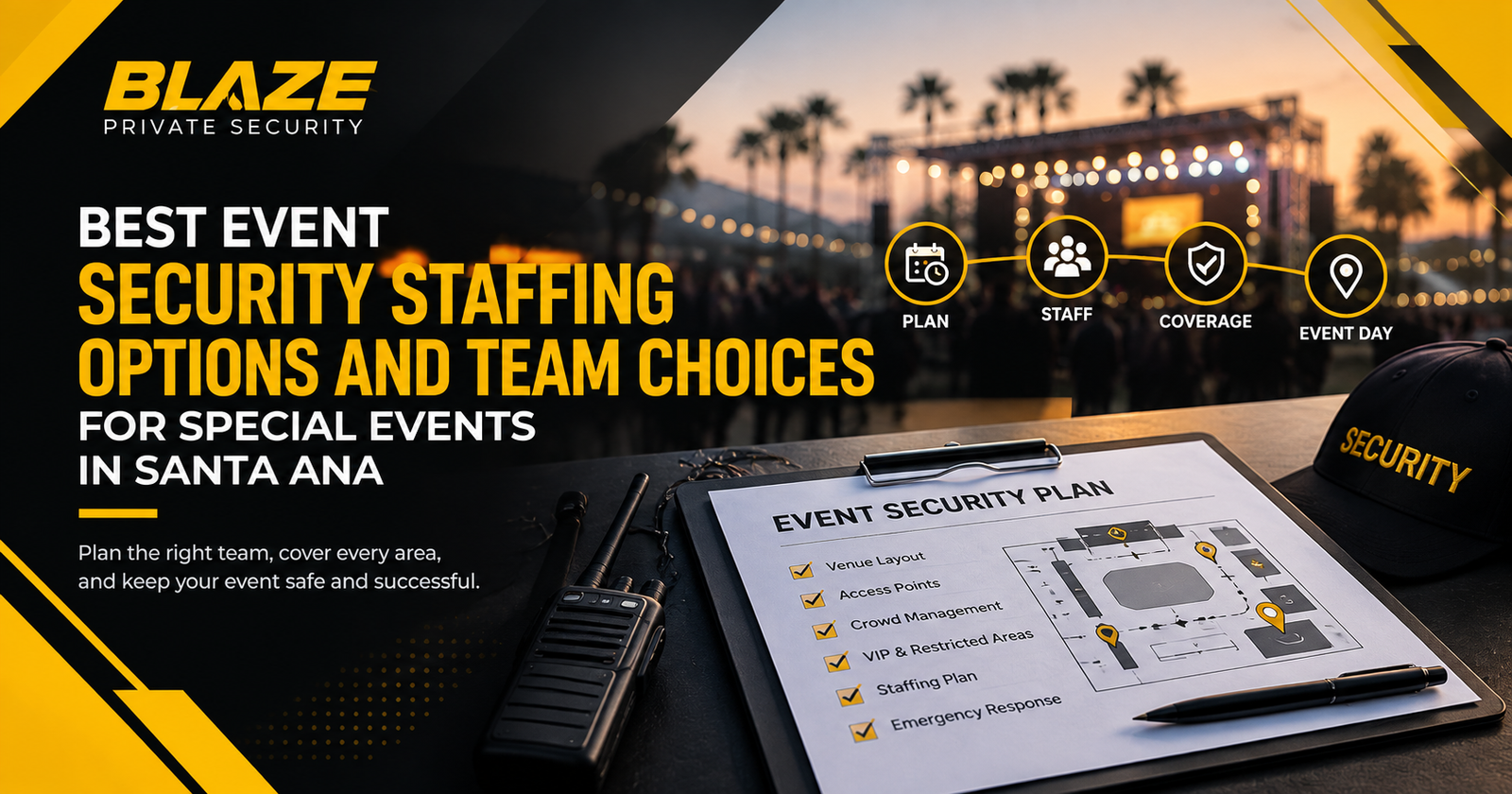
Choosing the Right Event Security Staffing for Your Santa Ana Event
When you're putting together an event in Santa Ana, one of the first security questions we hear is, "How many guards do we need?"
It's a fair question, but guest count alone doesn't give you the answer.
A 300-person event with one controlled entrance, a compact indoor venue, and no alcohol can need a very different security setup from a 300-person outdoor event with several access points, parking areas, alcohol service, and a large open space.
When we build an event security staffing plan, we look at the whole picture. The goal isn't to put as many guards as possible on site. It's to put the right people in the right places, for the right amount of time, so there aren't gaps in coverage when the event gets busy.
For a broader look at event protection and planning, see our guide to event security services and protection options in California.
What Event Security Staffing Actually Means
Event security staffing is more than deciding how many security guards to hire.
A good staffing plan answers several practical questions:
- Where does security need to be posted?
- How many entrances and exits need coverage?
- Who is watching the crowd?
- Who is covering parking and the perimeter?
- Is there a restricted or VIP area?
- Who responds if something starts happening somewhere else?
- Who supervises the security team?
- Does the team need to change as the event moves from setup to peak attendance to closing?
Those decisions are what turn a group of security guards into an actual security team.
For us, the starting point is always the event itself. We want to understand the venue, the schedule, the expected attendance, the type of crowd, and anything unusual about the event before deciding what personnel are needed.
What Determines How Many Security Personnel an Event Needs?
There isn't a single guard-to-guest ratio that works for every special event. Guest count matters, but it is only one part of the staffing requirements.
Expected Attendance
Attendance is the obvious starting point. More people generally mean more potential access points, more movement through the venue, and more areas that need to be monitored.
But headcount shouldn't be used in isolation.
For example, 500 guests entering through one controlled entrance are easier to cover than 500 guests arriving through several entrances spread across a large property. The second event may require additional personnel simply because there is more ground to cover.
Venue Layout and Access Points
Before assigning security personnel, we look at the physical layout.
Entrances, exits, parking lots, hallways, stages, restricted rooms, loading areas, and outdoor spaces can all create separate coverage needs.
An entrance guard can't also provide continuous coverage of a distant parking area. If those areas both need attention, they need to be accounted for in the security plan.
This is one reason we prefer looking at the venue rather than giving an organizer a number based only on attendance.
Alcohol and Event Activity
Alcohol can change the security picture considerably, particularly when it is being served to a large crowd or the event continues late into the evening.
The type of event matters too. A seated corporate gathering, a wedding reception, a community celebration, and a high-energy public event can have very different staffing requirements even when their attendance numbers are similar.
Event Location and Scope
Santa Ana event planning can involve factors beyond the guest list. The size and scope of an event, its location, and whether alcohol is involved can affect the security considerations associated with it.
That is why local event requirements should be considered early rather than treating security as something to figure out immediately before the doors open.
VIPs and Restricted Areas
Some events have areas that shouldn't be open to everyone.
That might be a backstage area, a private meeting room, a cash-handling location, an executive area, or a VIP section.
Those areas may require dedicated coverage rather than relying on a guard stationed somewhere else to keep an eye on them.
Event Schedule and Shift Coverage
Security needs can change throughout the day.
You may need personnel during setup, but the busiest period might be guest arrival. The team may then need to stay at full strength during the main portion of the event before shifting its focus toward departures and closing.
We don't recommend treating the entire event as one identical security shift when the activity changes significantly throughout the day.
Common Security Staffing Roles for Special Events
Not every event needs every role below, but thinking in terms of assignments helps clarify what the security team actually needs to accomplish.
Entrance and Access-Control Guards
These officers control the main points where people enter the event.
Depending on the event, that can involve monitoring tickets or credentials, checking guest lists, directing people toward the appropriate entrance, and identifying unauthorized access.
If an event has multiple entrances, each additional access point needs to be considered when building the staffing plan.
Crowd-Monitoring Personnel
Crowd monitoring is about seeing problems early.
Our officers watch how people are moving through the space, whether an area is becoming overcrowded, and whether tensions are beginning to develop.
The objective isn't to wait for a confrontation. It's to notice the warning signs early enough that the situation can be addressed calmly.
Perimeter and Parking Coverage
Parking areas and the perimeter are easy to overlook because they're often away from the main event.
Depending on the venue, these areas may still need regular or dedicated coverage. This is particularly important when guests are moving between parking and the event, when the property is large, or when there are areas that aren't visible from the main security posts.
Roaming and Response Guards
A roaming officer provides flexibility that a fixed post doesn't.
Instead of staying at one entrance throughout the event, a roaming guard can move through designated areas, check less visible parts of the property, and respond when another member of the team needs assistance.
This can be particularly useful at larger venues where security can't see everything from one location.
Security Supervisor or Team Lead
As a security team gets larger, coordination becomes increasingly important.
A supervisor can keep track of assignments, communicate with event management, address changing coverage needs, and make sure officers understand their responsibilities.
You don't want every officer trying to make separate decisions about where the team should move. There should be a clear chain of communication.
How to Think About the Guard-to-Guest Ratio
You'll find plenty of general recommendations about how many security guards should be assigned to a certain number of guests.
We don't treat those numbers as a final staffing formula.
A ratio can be a useful starting point, but it doesn't account for the things that can make one event substantially different from another.
Consider a realistic example: a Santa Ana community organization is holding a Saturday evening fundraiser at an outdoor venue. The organizers expect around 400 guests. There are two public entrances, a separate parking area, a bar serving alcohol, and a small VIP section near the main event area.
The organizer might initially look at 400 guests and ask whether four or five guards are enough.
But the actual staffing question is more complicated. Someone needs to manage the entrances. Someone needs to keep an eye on the main crowd. The parking area cannot simply be forgotten once guests arrive. The VIP section may need attention, and someone needs to be able to move when an issue develops somewhere outside the main coverage points.
The important point isn't whether that event ultimately needs a particular number of guards. The point is that the staffing plan has to account for the posts and responsibilities that exist at the event.
That's why we don't take a guest count, multiply it by a generic ratio, and call the job finished.
Building an Event Security Team in Santa Ana
When we plan staffing, we generally work through the event in a practical sequence.
First, we understand the event.
We look at the type of gathering, expected attendance, operating hours, guest profile, alcohol service, VIP considerations, and anything else that could affect the assignment.
Then we look at the venue.
We identify entrances, exits, parking, restricted areas, blind spots, high-traffic areas, and other locations where security personnel may be needed.
Next, we establish coverage points.
Rather than simply assigning a number of guards, we determine what each officer is actually responsible for.
Then we plan the shifts.
The staffing needed during setup may not be the same as the staffing needed during peak attendance or closing.
Finally, we establish communication and supervision.
Everyone needs to know who is responsible for what, who they report to, and how the team communicates when something changes.
That process produces a much more useful security plan than simply multiplying the guest count by a standard ratio.
Santa Ana Event Security Requirements to Keep in Mind
There are also situations where event organizers need to consider local requirements in addition to their private security plan.
Santa Ana's event planning process can take factors such as event size, alcohol, location, and overall scope into account when determining public-safety considerations.
That distinction matters: private security and law enforcement are not the same thing.
A private security team can provide access control, monitoring, crowd management, perimeter coverage, and other security functions. It does not replace police services or any public-safety requirement that may apply to a particular event.
We recommend sorting those requirements out early, particularly for larger public events or events with alcohol.
It's also worth confirming that the people working your event are properly registered and trained for California security work. California requires security guards to meet state registration requirements, including background screening and required training. Ongoing training is also part of maintaining the registration.
For an event organizer, that's one of the simplest things to verify before putting a security team on the schedule.
When Should You Increase or Adjust Security Staffing?
The original staffing plan may need to change when the event changes.
We would revisit the plan if:
- attendance grows significantly;
- another entrance is added;
- the venue layout changes;
- alcohol service is added or expanded;
- a VIP or restricted area is introduced;
- the event moves outdoors;
- parking arrangements change;
- the event runs longer than originally planned;
- the peak attendance period changes;
- weather or other conditions alter how the venue is being used.
This is also why we prefer communication between the event organizer and security provider before the event rather than treating the original staffing number as permanent.
A small change in the event can create a meaningful change in coverage.
What to Ask an Event Security Company Before Booking
Before hiring event security staffing in Santa Ana, ask the provider how they arrive at their staffing recommendation.
A good conversation should cover questions such as:
- How will you determine how many security guards my event needs?
- Will someone review the venue layout?
- How will guards be assigned?
- Will there be a supervisor?
- How will shift coverage work?
- How will your team coordinate with event staff?
- Are the officers properly registered and trained?
- Does your team have experience with events similar to mine?
- What happens if attendance or the event layout changes?
The answers tell you more than a simple hourly rate or a promise to provide a certain number of guards.
You can also review Blaze's full range of security services and the industries we serve to see how our event work fits within our broader security operations.
How Blaze Approaches Event Security Staffing
At Blaze, we don't believe event security should be built around a generic number pulled from a chart.
Our approach is to understand what the event actually looks like and build coverage around it.
That means considering the venue, access points, guest flow, staffing roles, schedule, and specific concerns before assigning personnel. We also put a strong emphasis on the quality of the officers assigned to the event, not just the size of the team.
Every officer working in California needs to meet the state's requirements, but we believe the job doesn't stop at the minimum. Our hiring and training approach is built around having officers who can communicate with the public, recognize developing problems, respond appropriately, and work as part of a coordinated team.
For an event organizer, that's the difference between simply having guards present and having a security team that is actually prepared for the event.
If you're planning an event in Santa Ana and want to discuss the staffing requirements, you can review our special event security services and contact Blaze to discuss the event before finalizing your security plan.
FAQs
How many security guards do you need per 100 people?


There is no fixed ratio that works for every event. The right number depends on factors such as the venue layout, entrances, event activities, alcohol service, and areas requiring dedicated coverage.
How many security guards do I need for an event?
It depends on the event size, venue, access points, schedule, and security risks. At Blaze, we assess these factors to determine how many guards and which positions are needed for effective coverage.
What factors determine how many security guards an event needs?
Key factors include attendance, venue layout, entrances and exits, alcohol service, parking, restricted areas, event duration, and expected crowd activity. These details help determine where guards should be positioned and when additional coverage may be needed.
What types of security personnel are needed for an event?
Depending on the event, security staffing may include entrance guards, crowd-monitoring personnel, perimeter or parking guards, roaming guards, and a security supervisor. The team is organized around the specific coverage needs of the event.
What are the main responsibilities of event security guards?
Event security guards typically control access, monitor crowds, protect restricted areas, identify potential problems, and respond to incidents. They also communicate with event staff to help maintain a safe and orderly environment.
References
Bureau of Security and Investigative Services. (2025). Security guard registration. California Department of Consumer Affairs. https://www.bsis.ca.gov/forms_pubs/guard_fact.pdf
City of Santa Ana. (n.d.). Santa Ana Municipal Code. Municode Codification. https://library.municode.com/ca/santa_ana/codes/code_of_ordinances
City of Santa Ana. (2025, May 7). Special event application 2025. https://www.santa-ana.org/documents/special-event-film-street-closure-application/new-special-event-application-2025/